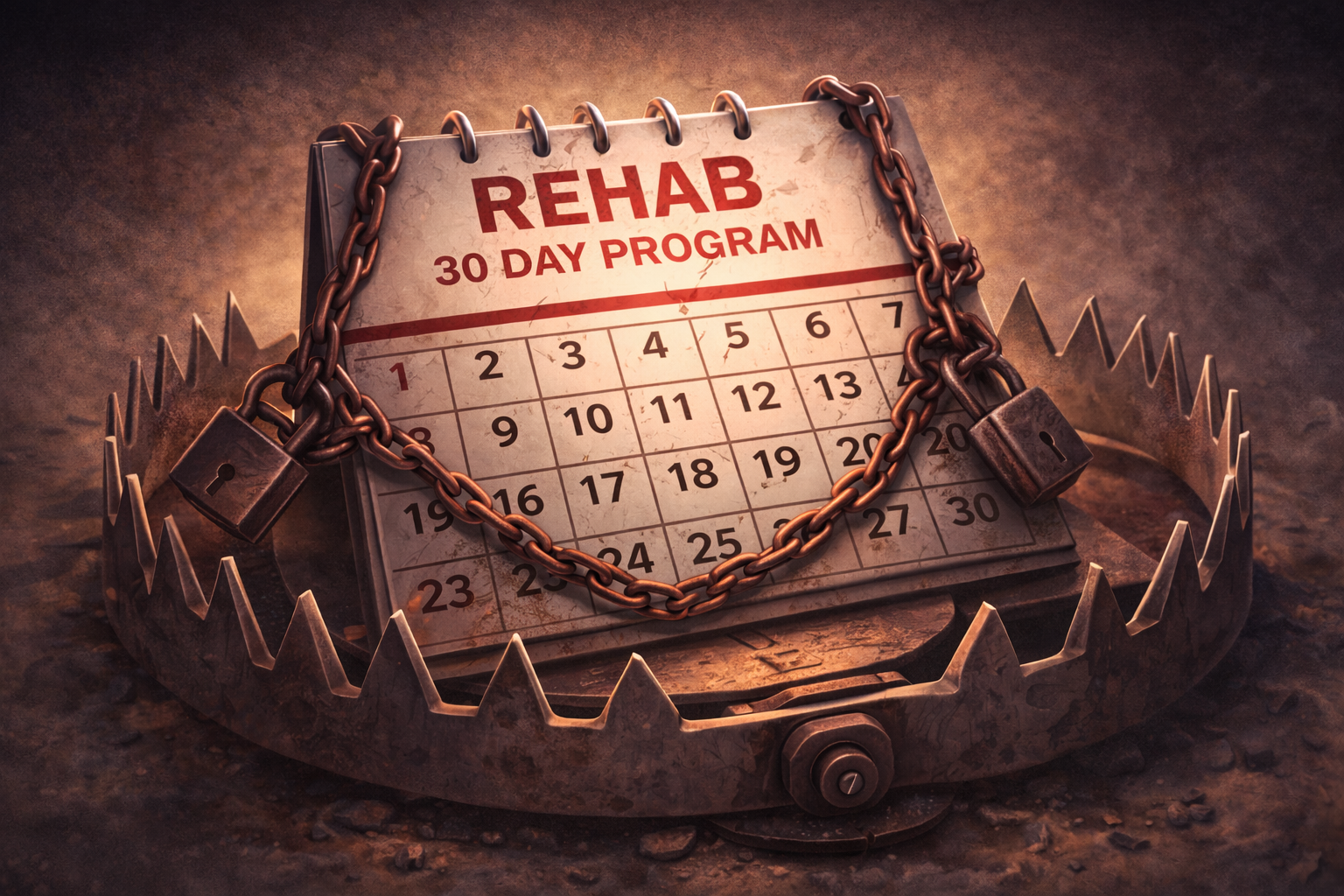
After his third time in a 28-day program, the frustration was unbearable – not just for him, but for his entire family. His mother had remortgaged her home. His wife had run out of hope. And the cycle kept repeating: check in, dry out, come home, relapse. If this sounds painfully familiar, the problem isn’t a lack of willpower. The problem is that 30 days was never enough.
The standard 28-to-30-day rehab program has become the default in the American treatment industry. But here’s the uncomfortable truth: this timeline was never based on science. It was born from insurance policy and military logistics – and it has been failing families for decades.
The Origin of 28 Days: Insurance, Not Evidence
The 28-day rehab model didn’t emerge from a clinical breakthrough or a rigorous study. Its roots trace back to the 1950s U.S. Air Force, where servicemen could be away from their units for a maximum of 28 days without requiring an official transfer. Convenience, not medicine, set the clock.
Around the same time, Daniel Anderson at Willmar State Hospital in Minnesota developed what became known as the “Minnesota Model” – a structured 28-day inpatient program designed to move men through early sobriety. The approach spread to Hazelden and eventually became the template for treatment centers nationwide.
As Anne Fletcher, author of Inside Rehab, has stated plainly: “The 28-day standard certainly is not scientifically based.” Insurance companies simply adopted the timeline because it was already common practice. It was affordable and predictable – but not effective.
What the Science Actually Says
The National Institute on Drug Abuse (NIDA) is unequivocal: “For residential or outpatient treatment, participation for less than 90 days is of limited effectiveness, and treatment lasting significantly longer is recommended for maintaining positive outcomes.”
This isn’t opinion. It’s the conclusion of decades of clinical research.
Dr. D.D. Simpson’s landmark Drug Abuse Treatment Outcome Study (DATOS) found that the first 90 days represent the minimum retention threshold before therapeutic effects begin to take hold. Patients who left treatment before this point were significantly more likely to relapse, while those who stayed a year or longer were nearly five times more likely to achieve lasting recovery.
The numbers tell the story:
- Programs lasting less than 30 days show a roughly 30% success rate
- 90-day programs reach approximately 70–80% success rates
- Two-thirds of all relapses occur within the first 90 days of recovery
A pivotal study published in the Archives of General Psychiatry found that 35% of individuals in treatment for less than 90 days reported drug use the following year, compared to just 17% of those who completed 90 or more days – a 51% reduction in relapse.
Why Your Brain Needs 90 Days
Addiction fundamentally changes the brain. Substances hijack the reward system, flood it with dopamine, and gradually rewire the neural pathways responsible for decision-making, impulse control, and emotional regulation. Reversing that damage takes time – far more than four weeks.
Research from NIDA Director Dr. Nora Volkow’s brain imaging studies shows that dopamine transporters in the brain’s reward center require months to recover. After just one month of abstinence, brain scans of methamphetamine users still showed significantly reduced activity compared to healthy controls. It wasn’t until 14 months of sustained sobriety that dopamine function approached normal levels.
For the prefrontal cortex – the region responsible for judgment and self-control – most experts agree that approximately 90 days of abstinence is the threshold for regaining basic decision-making capacity. Even then, deeply ingrained habits may require 6-9 months of consistent, healthy behavior to fully replace.
In simpler terms: asking someone to sustain recovery after only 30 days is like asking them to run a marathon on a broken leg that hasn’t finished healing.
The Hidden Cost of Short Programs
Families often choose 28-day programs because they appear less expensive. But when the cycle of admission, relapse, and readmission is factored in, short programs become a far costlier choice – financially and emotionally.
Consider this: a man who cycles through three separate 30-day stays (plus the emergency room visits, lost wages, and family disruption in between) will spend far more than he would on a single, comprehensive 90-day residential program. And the emotional toll on families – the broken trust, the fear, the exhaustion – compounds with every failed attempt.
The CDC reports that excessive alcohol use alone costs the U.S. economy roughly $249 billion per year in lost productivity, healthcare, and related damages. Investing in effective treatment isn’t just the right thing to do – it’s the economically sound thing to do.
What Can Actually Happen in 90 Days
A 90-day treatment program isn’t simply a longer version of a 30-day one. The additional time allows for treatment phases that short programs cannot accommodate:
- Weeks 1-3: Stabilization. The body adjusts. Medical needs are addressed. The fog begins to clear.
- Weeks 4-8: Deep Therapeutic Work. This is where the real healing begins – trauma therapy, EMDR, individual counseling, and group work. A 30-day program would be discharging the patient right as this critical phase starts.
- Weeks 9-12: Integration and Life Skills. Residents practice what they’ve learned. They build daily habits, develop coping strategies, work through the 12 Steps, repair family relationships, and prepare a concrete plan for life after treatment.
At Augustine Recovery, this 90-day structure is the foundation of everything we do. Our men’s residential program ensures that residents don’t just detox – they transform. They complete all 12 Steps before discharge, engage in fitness and outdoor therapy that rebuilds physical vitality, and participate in family programming that begins to restore broken trust.
It’s the difference between putting a bandage on a wound and actually letting it heal.
Why Families Keep Falling into the Trap
The 30-day model persists because it’s familiar. Insurance companies still default to it. Marketing from large rehab chains reinforces it. And desperate families, eager for a quick solution, understandably gravitate toward the shorter timeline.
But if your loved one has been through a short program and relapsed, you’re not alone – and it’s not your fault. The system was designed around cost management, not clinical outcomes. The research is clear that more time in treatment produces dramatically better results.
If you’re navigating insurance questions about coverage for a longer stay, know that many out-of-network plans will cover a significant portion of 90-day treatment when medical necessity is documented. A quality treatment center will advocate on your behalf to maximize benefits.
A Better Path Forward
Recovery is not a 28-day transaction. It’s a process that requires the time, structure, and clinical depth to address the full picture – the trauma underneath the addiction, the co-occurring mental health conditions, the broken relationships, and the lost sense of identity.
As one physician put it: if a doctor prescribed six months of chemotherapy, no one would insist on stopping after two. Addiction is a chronic brain disease that deserves the same standard of care.
The data is clear: giving your loved one the gift of time in recovery can mean the difference between relapse and a lifetime of freedom. Augustine Recovery is founded on this principle – and we see its impact every day on our eight-acre campus in St. Augustine, Florida.
If your family is caught in the cycle of short-term treatment and relapse, there is a better way. Contact Augustine Recovery to learn how our 90-day immersive program gives men the time they need to truly heal – or call us directly at (904) 217-0480.
Related reading: – Healing Hidden Wounds: Trauma-Informed Addiction Recovery – Healing Together: Why Family Involvement Matters – Whole-Man Wellness: Beyond Talk Therapy in Recovery
Sources:
- National Institute on Drug Abuse, Principles of Drug Addiction Treatment: A Research-Based Guide, Third Edition.
- Simpson, D.D., “Drug Abuse Treatment Outcome Study (DATOS),” Archives of General Psychiatry, 1999.
- Fletcher, Anne, Inside Rehab: The Surprising Truth About Addiction Treatment, 2013.
- NPR Health, “How We Got Here: Treating Addiction in 28 Days,” 2016.
- Volkow, N.D. et al., “Loss of Dopamine Transporters in Methamphetamine Abusers Recovers with Protracted Abstinence,” Journal of Neuroscience, 2001.
- CDC, “Excessive Alcohol Use Costs U.S. $249 Billion,” 2018.